
First Instruction
The Christian at Mass, Rev. Joseph L. Andreis
.. dearest, as introduced here. My ongoing little Mass commentary on this work can be found here.
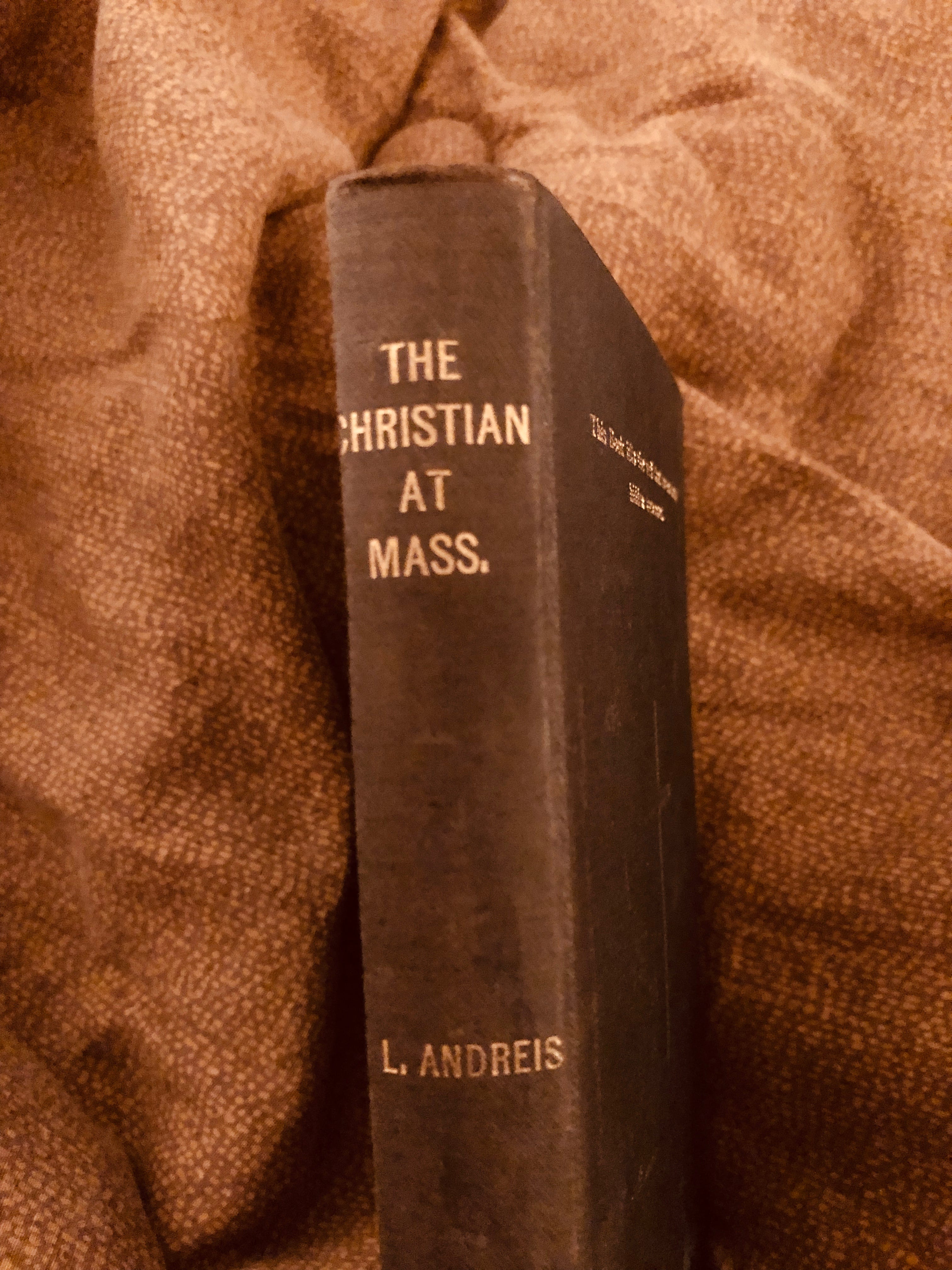
With the approbation of His Eminence James Cardinal Gibbons, Archbishop of Baltimore, 1896.
When he leaves his house, to be present at the offering of the Adorable Sacrifice of the Mass, the Christian shows that he is aware of St. Paul’s saying: “We have not here a lasting city, but we seek one that is to come;”1 That faith teaches him that God has made him for heaven, his only lasting home; and that he remembers the words of Christ spoken after His last supper: “In My Father’s house there are many mansions. … I go to prepare a place for you.”2
He also shows he believes that by the offering of Masses and other suffrages for souls in Purgatory, he intends to hasten their entrance into the place he craves for himself — heaven. Whenever he thinks of, or celebrates the feast of All Saints, he is irresistibly forced to ask himself: “Shall I also be of their number? Shall I also stand with them before the throne of God and in the sight of the Lamb, clothed with white robes, and holding a palm in my hands? Shall I join them in singing praises to God, and to the Lamb? Shall I also be led to drink at the fountains of the waters of life, and have God wipe away all tears from my eyes?”
The Angel of Faith whispers, that just as he now passes from his house to the house of worship, so will he pass from the Church Militant to the Church Triumphant; and just as he now comes before the Altar whereon the Divine Lamb is slain and for his redemption, so will he go before the throne of His glory in heaven. It is to realize these longings that the Christian comes before the Altar, and follows step by step the Divine Victim Who offers Himself in sacrifice as on Mount Calvary through the ministry of the Priest empowered by Him. The Christian believes that this Divine Victim is the Blessed Saviour Jesus Christ, who is morally present in His Priest personating Him; the Christian also firmly believes that Jesus Christ is physically present in that which the Priest offers; and, therefore He, by means of the Priest, as his intelligent instrument, offers sacrifice, and in that sacrifice He is Himself the Victim. Hence, by assisting at Mass, the Christian adores Him, thanks Him, supplicates Him for the grant of the graces necessary to fidelity, of pardon for infidelities, and of mercy to supersede the too-well-deserved rigor of justice.
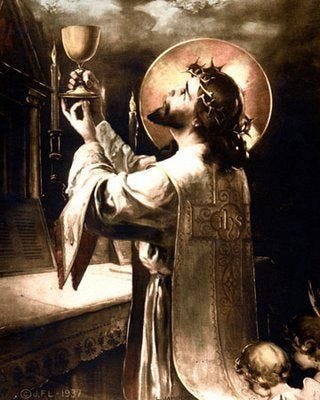
With his soul thus predisposed, and his body reverently postured, the Christian beholds the Priest in his sacerdotal vestments and with a veiled chalice in his hands, advancing with grave composure from the Sacristy to the Sanctuary, and he piously imagines he sees the Lord Jesus Christ just coming from His last supper-chamber, Who, in company with only three of His Apostles, namely, Peter, James and John, directs His divine steps to the country place called Gethsemani. The place whereon the Priest puts the veiled chalice reminds the Christian of the lonely spot in Gethsemani, which Jesus selected to prepare for His sacrifice.
When the Priest goes to the Epistle side and opens the book called the Missal, the Christian thinks of Judas Iscariot on his way to the high priest and the princes of the Jews, to open his mind to them concerning his vile plan of delivering his Divine Master into their hands.
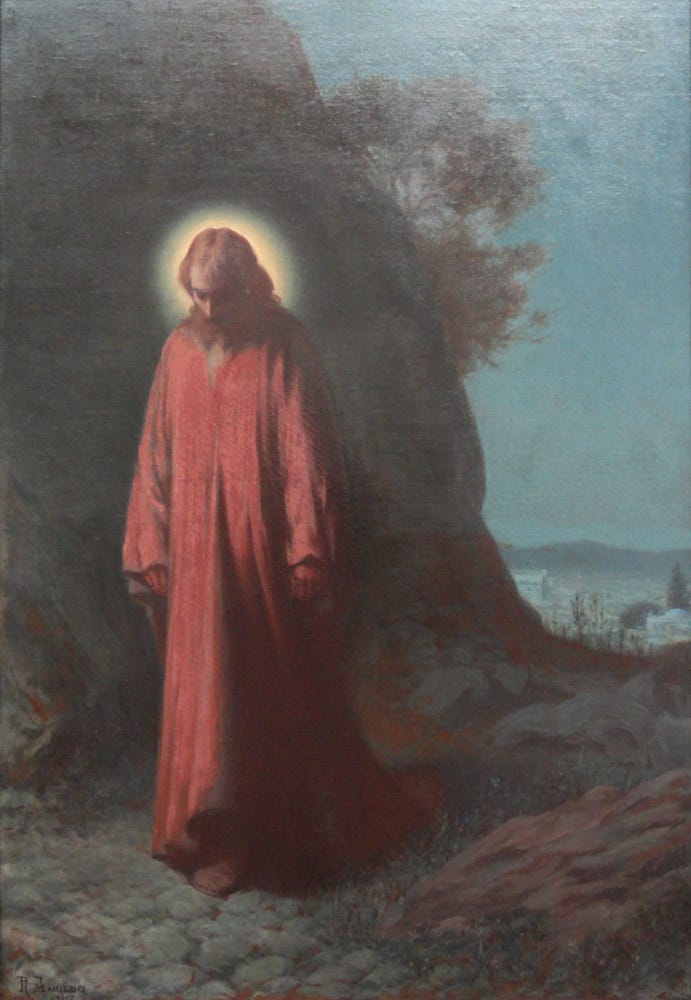
In the descending of the Priest from the Altar to its lowest step, the Christian sees Christ, Who, being conscious of the dark doings of His faithless disciple, “begins to fear and feel sorrowful;”3 bids His three Apostles “watch and pray that they may not enter into temptation;”4 and, “withdrawing away a stone’s throw from then, He Himself kneels down to pray.”5 The Christian is struck the carefully chosen wording used by St. Luke in qualifying as a withdrawal the leaving of Jesus from His company, and sees its meaning, namely: that in the condition of great sadness from which he was suffering, His natural inclination prompted Him to remain with his friends; but, following the counsel of His own spirit, He tore Himself away from them in order to be alone with His Heavenly Father, and thus seek comfort and consolation in Him instead of in men.
With this example, before his eyes, the Christian learns that in his afflictions he must not put his chief hope of consolation in man, nor immoderately seek after earthly satisfactions; but first, as St. James says, crave at God’s hands, and expect them from Him,6 after the example of the prophet David, who said: “My soul refused to be comforted; I remembered God, and was delighted.”7
When the Priest at the foot of the Altar begins the Mass by making the sign of the cross on himself and reciting the 42d Psalm, the Christian imagines he sees the terrible scene of sufferings and death on the cross as it was present to the mind of Christ, and perceives how terribly it affected Him, since it so overcame Him as to cause Him to “fall flat on the ground,”8 and suffer such great agony a to sweat blood so that its “drops were trickling down upon the ground.”9 At this juncture the Christian is informed by St. Luke that, “being in agony, Christ prayed the longer;”10 and is told by St. Matthew that Christ’s prayer was: “My Father, if it be possible, let this chalice pass from me. Nevertheless, not as I will, but as thou wilt.”11
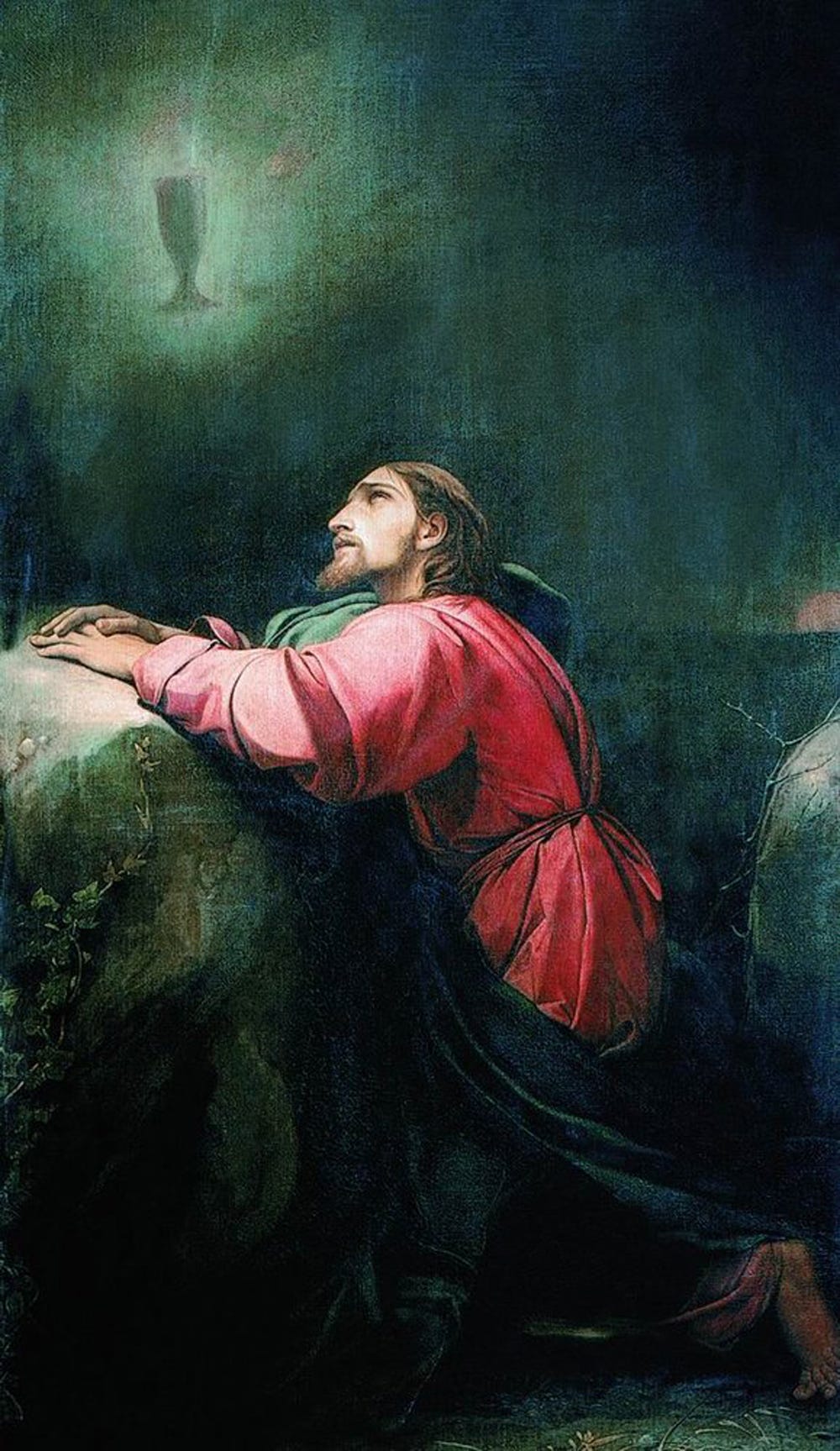
It is when the Priest profoundly inclines to recite the Confiteor, that the Christian pictures to himself the agonizing Jesus expostulating with His Eternal Father, and apprehends in that prayer the intense combat between His inferior will and His superior will — the will of the flesh and the will of the spirit.
The inferior will, the will of the flesh, refused to suffer and meet the ignominious death of the cross, because of the natural repugnance to suffer and die, and because it seemed vain that He should submit to His Passion for the sake of people who had persistently resisted Him, persecuted Him, and were now seeking His destruction; nay, even for the sake of His very disciples, for they had forsaken Hin. But His superior will, the will of His spirit, which constantly was subject to the will of His eternal Father, as He Himself had formerly declared, saying: “I do always the things that please Him,”12 demanding the surrender of His inferior will: “not as I will, but as thou wilt.” The redemption and salvation of mankind had to be accomplished through His Passion and death; hence, with His superior will, Jesus said to His Heavenly Father: “as thou wilt that I should suffer and die for the redemption and salvation of all men, so I also will it.”
Concerning the prayer which Christ repeated for the third time, namely: “My Father, if it be possible, let this chalice pass from me. Nevertheless, not as I will, but as thou wilt,” the Christian bears in mind the explanations which St. Ambrose and St. Catherine of Siena offer as received through special revelation from Christ Himself, namely: 1st, that by that prayer Christ manifested Himself exceedingly anxious to drink the chalice of His Passion and death, that He might show His intense love for His Father, and redeem all men; that He was therefore so longing for the moment to accomplish this great work, that He must have said: “My Father, my desire to suffer and die is so intense that any delay, even of an hour, nay, of a minute, is agonizing; let then this chalice pass by my drinking the whole of its bitter contents, that I may thus conquer death and at once return to Thee.” In fact He had expressed this desire on former occasions; for instance, when He said: “I have a baptism, wherewith I am to be baptized, and how am I straitened until it be accomplished?”13 Again, when immediately before His Passion, He said: “with desire I have desired to eat this pasch with you.”14
The explanation given by St. Catherine of Siena is that, foreseeing that many would be ungrateful to His Passion, remain in sin, and be eternally lost, Christ felt greatly grieved, and called this grief a chalice. Hence His expostulation with His Heavenly Father: “Let this chalice pass from me,” as if He had said: “Take away this great grief from me; prevent so many men from being lost, and grant that all my be saved.” The Christian knows that had Christ earnestly asked this, it would have been granted Him, for the Father would not refuse His Son; but christ would rather conform to the will and justice of His Father, and hence he said: “Not my will, but thine be done.”15
The Priest Ascends the Altar Steps.
In him, the Christian views Christ, Who of His own free will delivers Himself up into the hands of His enemies, to work out their redemption and that of all men: in fact, said he to His three Apostles; “Rise, let us go.”16 The avowed anxiety of Christ to suffer and die for the salvation of man is then expressed by the Priest, who, while ascending the Altar steps, says a prayer entreating God to show all men His infinite mercy by granting to them pardon for their sins, pity for their frail, and the grace to attain life everlasting.
Hebrews, xiii, 14.
St. John, xiv, 2.
St. Mark, xiv, 33
St. Matthew, xxvi, 38.
St. Luke, xxii, 41.
St. James, v, 13.
Ps. lxxvi, 4.
St. Mark, xiv, 35.
St. Luke, xxii, 44.
Ibid., xxii, 43.
Ibid., xxvi, 39.
St. John, viii, 29.
St. Luke, xii, 50.
Ibid., xxii, 15.
Ibid., xxii, 42.
St. Matthew, xxvi, 46.

My Intro - Old Mass Book
—
First Instruction - Priest moves from Sacristy to Sanctuary, Christ goes from the Last Supper chamber to Gethsemani, Christ’s mental agony, Christ offers Himself freely.
Second Instruction - Priest kisses the Altar, Judas kisses Jesus.
Third Instruction - Priest moves from Missal to the center of Altar, Christ is dragged, presented before Annas, Caiphas, false witnesses, Peter’s denial.
Fourth Instruction - Priest moves to the Missal, reads the Epistle, Christ brought before Pilate, Christ trial begins.
Fifth Instruction - Carrying of the Missal to the Gospel side, Priest inclines in the middle of the Altar, recites the MUNDA COR MEUM, Christ is brought before Herod, Christ is clothed with with a white garment, Christ doesn’t speak.
—
Parts of the Mass with Allegorical Meaning - from The Christian at Mass by Rev. Joseph L. Andreis - Google doc
—
Share this, leave a comment, or —